We’re often asked what the ROI is that a rights owner (or rights holder) could expect from a sports CDP and we give them an honest answer. Zero. Nada. Nil.
Not because CDPs don’t have value – they absolutely do – but a CDP doesn’t sell an extra ticket, shift another replica shirt, or convince one more fan to become a member.
The misconception comes from the fact that the benefits of a CDP are measured commercially, even though the CDP itself isn’t what creates those commercial outcomes.
Before you think I’m trying to talk you out of buying a CDP, let me explain.
A CDP as a standalone piece of software does not generate revenue. It enables better decisions that generate revenue.
What a CDP does is give a rights owner the information, confidence and operational capability to make those better decisions consistently and at scale.
The Right CDP
When a sports rights owner (or rights holder) chooses the right CDP, it enables:
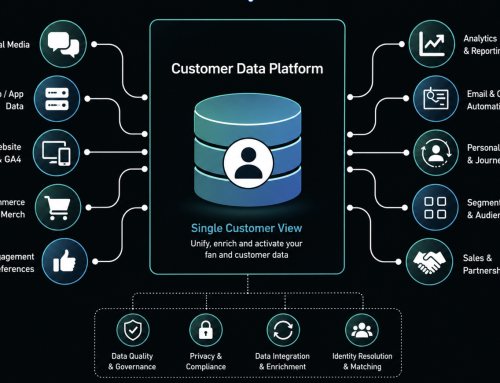
A Single Customer View (SCV)
Bringing every customer interaction and data source together into one trusted profile, even before you know who the customer is.
Better segmentation
While an email marketing platform (ESP) might provide segmentation capability, a CDP goes way beyond the usual limitations. For example, the right CDP won’t place a limit on the number of data fields, attributes or conditions you can use. Ideally you want the ability to make the decision based on what’s right for your business, your objective, and your campaign – not by the limitations of the software you’ve bought. While exposing too many data points could be confusing, the right CDP will allow you to hide/reveal as needed.
Better personalisation
A campaign CDP provides the personalisation function, but an analytics CDP ensures you know what that personalisation should be. While there will always be a point at which personalisation no longer delivers extra value, Amazon has the data to personalise every email differently. It doesn’t, because beyond a certain point the extra complexity delivers very little extra value. The right CDP tells you where that point is.
More accurate attribution
The right CDP improves attribution modelling by unifying customer interactions across channels and over time through fan identity resolution.
This is where the right CDP earns its place. When you can see identity, events and outcomes in one place, then you’re no longer reliant on just email clicks, UTM links, or ad impressions. You can combine every single customer identifier and tie it to one person. You can then track each customer as they visit your website, scroll through your app, and click on products. Then, when they buy, register, or engage, you know exactly how, when, and most importantly, why.
Greater commercial insight
It stands to reason that if you have accurate attribution, you then have greater insight. Knowing which activities contributed to the desired outcome gives you confidence: the confidence to do more of what works, less of what doesn’t, and to justify those decisions with evidence rather than instinct. (Note: we appreciate that sometimes we have to do things that don’t contribute to our commercial KPIs. Sometimes we have to do things…well, just because we do: the governance of a governing body, the health and safety of an event host, the safeguarding responsibilities of a youth academy, for example.)
Better investment decisions
Every rights owner has finite budgets, finite people and finite time. The right CDP doesn’t create more of any of them, but it does help you invest them more wisely. You operate with more efficiency which then results in a better ROI.
Predictive analytics
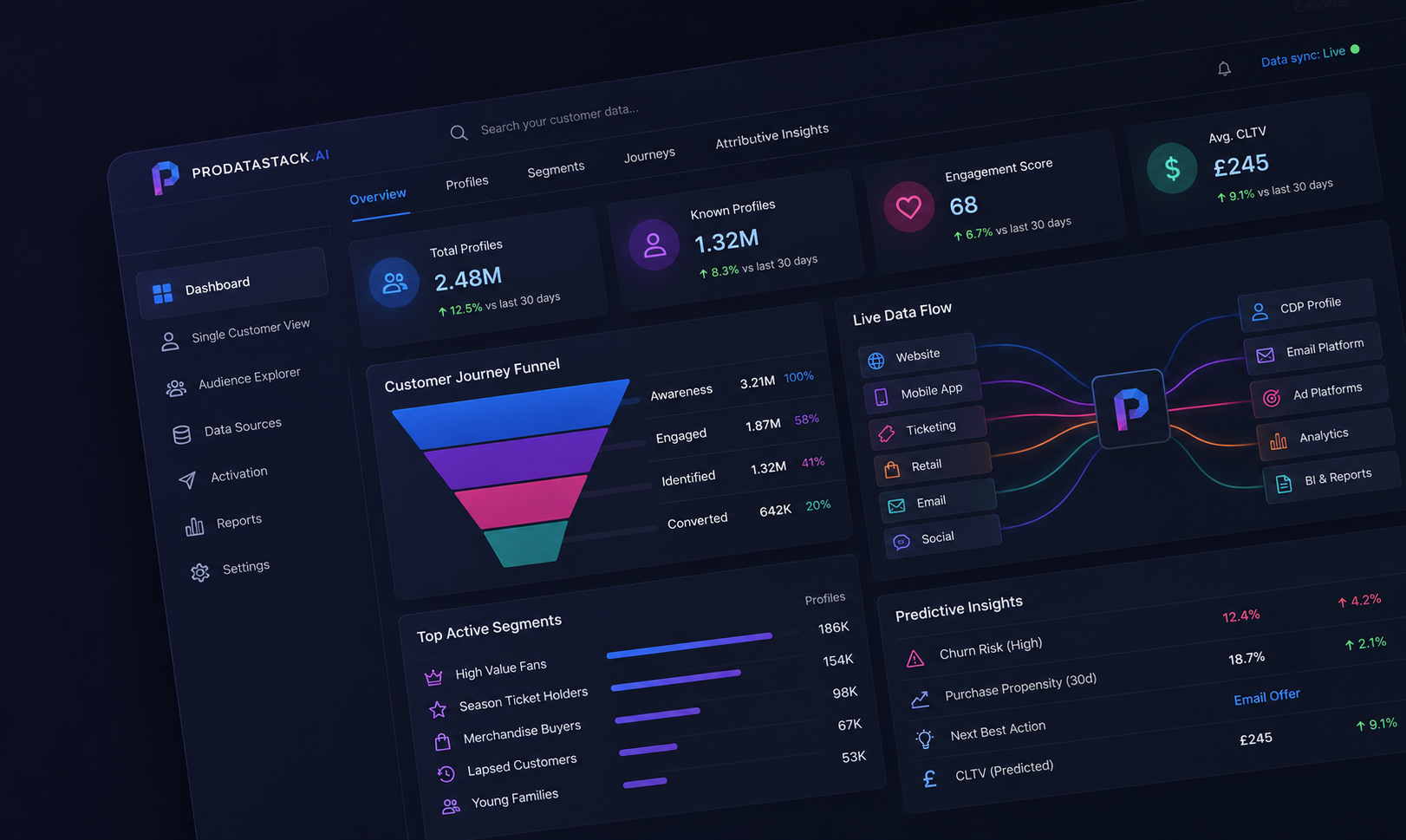
The right CDP will provide you with some powerful analytical capabilities. My two must-haves are churn prediction and Customer Lifetime Value (CLTV). Together, they help you identify customers at risk of leaving so you can take action to retain them, while understanding each customer’s long-term value so you know how much you can afford to invest in acquiring similar customers.
Why some CDP Projects Fail
If all of this sounds so straightforward, why do so many CDP projects fail to deliver the value that was promised?
There’s a statistic that’s been repeated for years: 80% of CRM projects fail. Whether the true figure is 80%, 60% or somewhere in between isn’t really the point. The misconception is that it’s the software that’s failing. In reality, when “it doesn’t work” it’s because of everything that goes on around the software: the implementation, the training, the understanding of what it should do, and the knowledge of how to do it. The software itself is never the only problem.
This is the same with CDP implementations. The functionality of CDPs varies enormously (hence my constant reference to “the right CDP”), but the reasons organisations fail to realise their value are pretty much the same:
Ownership: A CDP implementation needs an internal owner to ensure your purchase becomes a commercial asset, not just another database.
Data quality management: They say “muck in, muck out”. Whether it’s a CDP vs a DMP or an ESP (don’t you love all these acronyms?) if the data going in is incomplete, inaccurate or duplicated, the insight coming out will be equally flawed. The right CDO helps you wuth your data governance.
User adoption: Even the right CDP delivers no value if people aren’t using it. There has to be a reason (or six*) to log in every day.
KPIs/success metrics: If you don’t define what success looks like before implementation, you won’t know if the CDP has made a difference.
Change management: A CDP enables business transformation – it isn’t an IT project. Unless people are taken on the journey, you’ll struggle to realise its value. You need a sports CDP strategy that acknowledges this.
* The right CDP would give even the most senior of management six reasons to log in every day.
Software is not a silver bullet
It never has been and it never will – but the right CDP can transform your business if you buy it with the end in mind and recognise that signing the contract is only the beginning.
So there you have it. I’m not afraid to say that a CDP won’t give you a direct ROI. But the right CDP will help you maximise the ROI of every decision you make. I’m also not afraid to say that buying a CDP without consideration for what comes with it, might result in failure.
If you want to know what the right CDP is, whether or not you’re even ready for one, and if you are, how you should approach it, talk to us about your sports CDP implementation.
We love talking all things data and when we do, it’s inextricably linked to business outcomes. Technology doesn’t create revenue – better decisions do. The right CDP simply helps you make more of them.
PS: if you haven’t already done so, it’s worth reading why sports organisations are investing in CDPs right now.