It’s not an entirely cookieless world – thank goodness – but we are retiring third party cookies, and we now reject way more tracking cookies than ever before. According to a 2025 study from Usercentrics, 46% of consumers are clicking “accept all” less often today than three years ago.
So let’s take a look at why this leads to the CDP “coming of age” and what that means for sports rights owners (or rights holders).
What is a CDP?
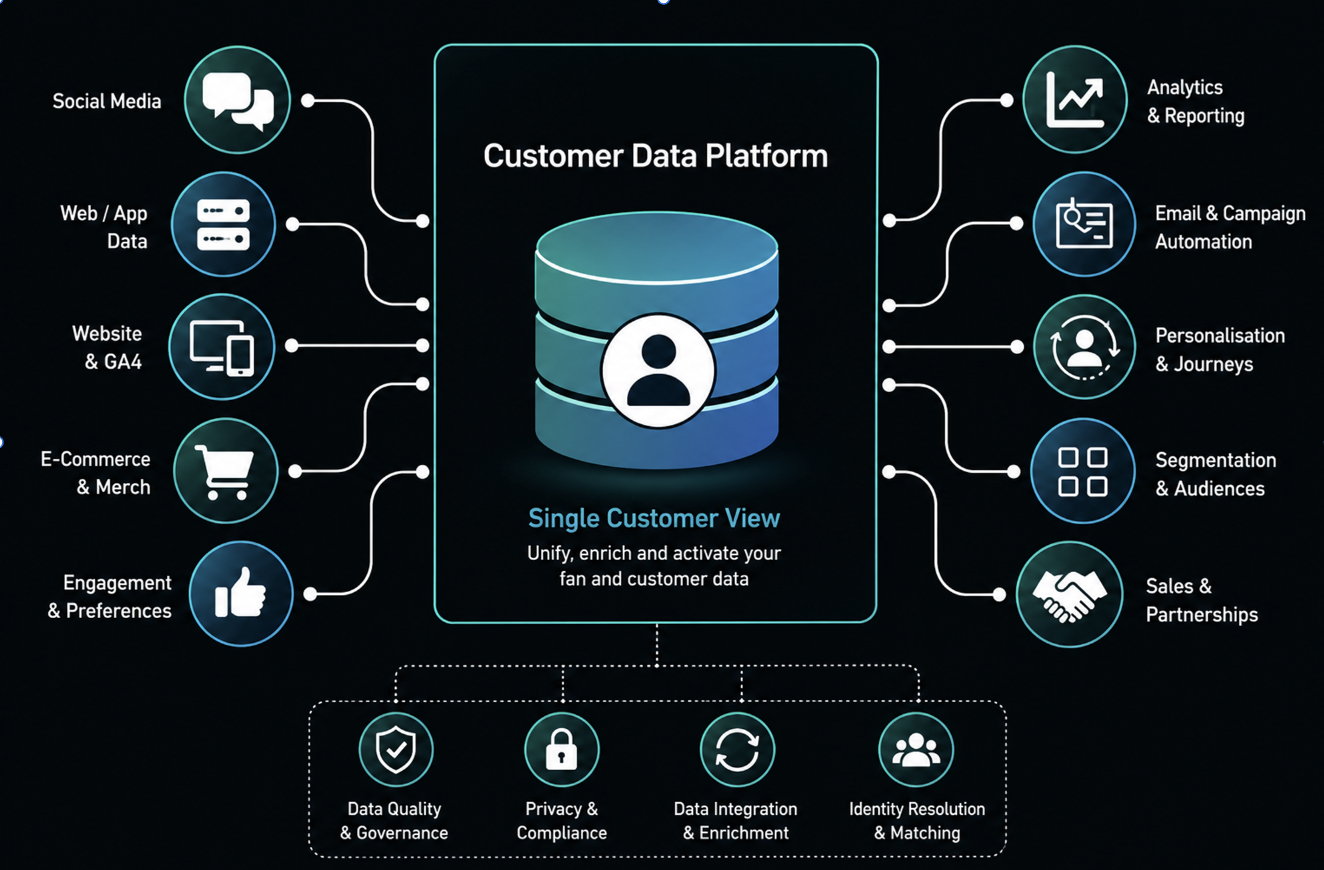
The CDP Institute’s 2026 definition of a Customer Data Platform is “software that creates and maintains a persistent, unified customer record that is accessible to other systems. The CDP assumes primary responsibility for defining and maintaining customer identity and customer record structure over time, and for providing a unified interface through which customer data services are governed and made operational.”
I’m not a huge fan of that definition. It’s too generic and would allow many applications to claim to be a CDP but the Institute does go on to further define four sub-categories of CDP. This precludes simplified data management “systems” from claiming a role in this space. Phew!
What is a DMP?
There’s no ambiguity here – a Data Management Platform stores limited data and it’s largely “anonymised”, i.e. directly linked to cookies and other IDs. It’s used to create audiences for digital advertising and media targeting.
Why does that Matter to a Sports Rights Owner?
Most rights owners are now building their first party data assets, even those that have only just started using email marketing and are not even aware of the asset value they’re creating. Typical data sources are ticketing, and membership systems, online stores, streaming platforms, and participation databases, all of which allow us to create a direct relationship with our fans and customers.
However while that focus on email addresses is an incredibly important metric – and one our business was founded on – it’s only one part of the audience journey. A fan doesn’t just buy a ticket, register for an account or subscribe to a newsletter – they may have visited your website and read articles, searched for a player, and viewed your fixtures long before they gave you their details.
Understanding more about that journey and being able to capture those touchpoints along the way, has become increasingly important as third party data has declined and the value of first-party relationships has increased.
Five Key Differences Between a CDP and DMP
- CDPs are built to deal with first party data – think email addresses and/or phone numbers. DMPs are primarily concerned with cookies.
- CDPs are designed for long-term data storage – DMPs retain data for months or sometimes just weeks.
- CDPs use first party data that has been acquired by the rights owner, even if it’s come via a vendor relationship (ticketing partner, online store, streaming platform, participation management software, etc.) DMPs use second- and third-party audience data.
- CDPs are built to support personalised marketing, analytics and deep customer understanding – DMPs build audiences and segments for digital advertising and media buying.
- CDPs can activate across many channels including email, SMS, web personalisation, display and social advertising, and mobile app push notifications. DMPs only support advertising platforms such as display, social, and programmatic media.
So why the Confusion?
When the differences are so clear it’s difficult to understand why there have been so many “CDP vs DMP” articles written over the years. The cynic in me could suggest it’s to confuse the readers into buying whatever product the author is representing. You might think I’m being unfair with that assessment, but it aligns with my long-held belief that some vendors sell software as a silver bullet. But it’s not – it’s a magnificent enabler, but we need people, processes and data to ensure the software delivers. And that doesn’t happen when you click “on”.
However, since the first “CDP versus DMP” articles were written, such as this one by eConsultancy in 2018, the lines have become a little blurred: a few DMPs are now storing email addresses and some CDPs are creating anonymous profiles. And that’s where the confusion stems from: the technology landscape has evolved faster than the terminology.
In 2013, when CDPs first emerged and David Raab, founder of the CDP Institute, first coined the term, the distinction was relatively straightforward: DMPs managed anonymous audiences and CDPs managed known customers.
But today customers want identity resolution, audience activation, analytics, personalisation and advertising all in one place. As a result vendors have expanded their capabilities and the lines that once separated these categories have become less visible.
The underlying principles remain different, but the practical use cases increasingly overlap.
The Opportunity for the Sports Industry
Here’s the reality for sports rights owners today.
We want to know as much as possible about our fans and customers and as a result, we’ve become obsessed with known customer data, starting with email addresses. That’s a good thing, a very good thing, but what’s even better is we no longer have to choose between two platforms: one that services known customer data and one that services the anonymous. We can use the same software to track our fans and customers from engagement to conversion.
Imagine a football fan Googling for tickets. They land on a club website, browse through several pages, then leave. They go back to the club website a week later, visit the online store, and look at the hospitality offering. Just a few days later a Meta ad shows them a competition to win match tickets and they enter it, providing their contact details.
Historically, the ability to track that journey would have been split across multiple systems, creating fragmented insight and limiting the ability to build a single customer profile.
But now, with modern CDPs, that very same football club can connect all these interactions into a single fan journey, not by knowing the individual from the beginning, but by recognising and capturing their behaviour along the way.
What Next?
This means the CDP versus DMP discussion becomes largely redundant, and this blog post along with it. But I’m going to leave you with a teaser now.
What about all those other fans we have out there – those that haven’t yet engaged with our content but know about us, talk about us, read about us? We have their attention, they just haven’t engaged with us, which means we can’t yet convert them. But knowing how many of them are out there, where they are, what they’re saying about us, how they’re thinking about us, would be a great start.
The next step is a platform that can do that for the sports industry: turning attention into engagement and engagement into conversion.
That’s the real challenge for the sports industry: it’s no longer understanding the fans it knows, it’s understanding the larger audience that is already paying attention.
The next generation of sports CDPs will not be judged by how they acquire, maintain and use known customer data but how they identify, measure, and influence the entire customer journey – from attention, to engagement, to conversion.
Get in touch if you’d like to know more about the CDP of the future.