Why CDPs Matter More Than Ever for Sports Rights Owners
Engagement, revenue, return on investment. Three things every sports rights owner (or rights holders) tells me they want more of. And three things that depend, more than most are willing to admit, on a handful of unsexy acronyms.
We love an acronym in the sports industry: FIFA, UEFA, NBA, NFL. But the ones that actually move the commercial needle are less glamorous. I’m talking about these: SCV, CLTV, ARPU, DMP, UDP, and the mighty CDP.
That last one, customer data platform is where I’m spending most of my time right now. And for good reason.
The SCV (single customer view) remains the holy grail of everything data. The CLTV (customer lifetime value) and ARPU (average revenue per user) are what we’re ultimately trying to grow. The DMP (data management platform) has largely lost its edge with the decline of third-party cookies. And the UDP (unified data platform)? Most of the industry isn’t quite ready for that yet.
But the CDP? That’s where it’s at.
The growing importance of first-party data has made it not just relevant but essential, and since the term was first coined in 2013, investment in CDPs across the sports industry has accelerated significantly.
Here are the five key reasons the sports industry should be investing in a CDP right now:
1. A Database Stores Data: a CDP Activates It
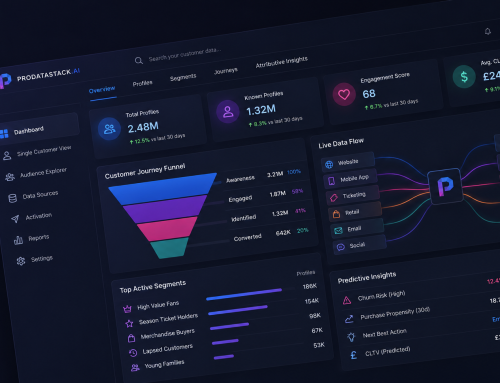
This might be the single most important distinction between what a rights owner might currently be using and a CDP. In addition to unifying customer/stakeholder data, resolving any “conflicts” during the process, the right CDP creates audience intelligence allowing you to create relevant segments for marketing campaigns, content and reporting.
A database tells you what happened – a CDP helps you decide what to do next. And an AI-native CDP won’t just help you decide what to do next, it will tell you exactly what to do, why you should do it, and what the outcome will be.
2. Identity Resolution: Bridging Unknown and Known Audiences
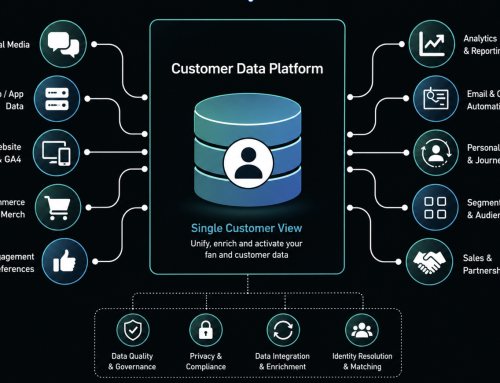
A single customer view has always been the holy grail of our industry and while an Excel can provide you with a foundational, static version of that, when you want to combine your ticketing, merchandise, hospitality and streaming customers, with your web activity, app behaviour, and social engagement, you need a CDP.
Building profiles of both your known, anonymised and unknown customers is the ultimate single customer view. The right CDP can provide you with that.
3. First-Party Data Is Now Strategically Essential
This has always been the case but now, with the opportunity to use third-party cookies declining, and the realisation that social followers are customers that belong to Bezos and Musk, it’s more evident that rights owners can no longer rely on rented audiences. Many rights owners have built audiences on platforms they do not own.
Add that to the seismic changes in the sponsorship industry, with brands needing more accountability for their investments, and the ability to track and report on their return-on-investment is the differentiator needed to secure more, and higher value deals.
4. Predictive Intelligence and AI Are No Longer Optional
CDPs provide out-of-the-box analysis although the extent of it will vary product to product. However modern CDPs will provide predictive analytics that support propensity for churn, purchase, or engagement, LTV (lifetime value) and sponsorship insights.
AI-native CDP’s can go beyond that, incorporating a ChatGPT-style assistant that will combine “external” large language models with the data stored within its own database. This provides an incredibly powerful opportunity to use queries such as “what segment should I create to sell these last 500 tickets”, “which platform should I use to promote this offer, what content should I use and when should I post it?”, “which financial services company would be most responsive to my sponsorship proposal and what data points should I highlight in my approach?”
5. CDPs Help Navigate Data Governance, Consent and Privacy
I’ve talked about this for a long time and even though it causes some folks to roll their eyes, I have to keep on talking about it, because it’s real and it’s important. But the message I always try to enforce is that it’s not a limiter to using data. So long as we are aware of, understand, and comply with the relevant legislation, we can still be successful with data. But I get that the GDPR, PECR, CCPA, CAN-SPAM, etc., can be complex so the right CDP will minimise your risk through consent and identify management, with controlled audience governance layers.
A CDP is not just marketing technology
Many people wrongly think CDPs are email systems, campaign tools, or a replacement for any of your outbound/push marketing software. While some CDP’s do provide push marketing functionality their core role should provide you with a commercial infrastructure that supports all areas of fan engagement and monetisation.
While a CDP can’t help the sports industry with results on the field, the next generation will allow rights owners to compete not only on content, but on audience intelligence.
Contact Us if you’d like to talk about CDPs, or anything else related to fan engagement, revenue generation, and the use of data in the sports industry.