Our business has evolved significantly over the past year, but the principles behind what we do haven’t changed.
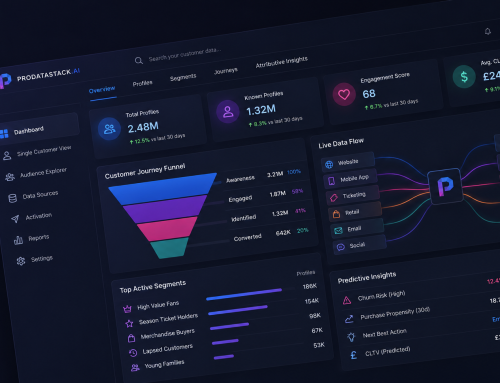
We rebranded from Winners to ProDataStack to better reflect where we are today: no longer a pure consultancy, but a business that solves problems with or without our proprietary technology. That shift was born out of a growing frustration that too much technology in our industry is still positioned as a silver bullet, rather than as an enabler of a broader, data-led solution. The name changed, the mission didn’t.
At the same time, we’ve focused our attention on a group that has been consistently overlooked when it comes to data: the athletes themselves. While clubs, leagues and governing bodies have made progress in using data to drive commercial value, the individuals at the centre of the ecosystem – the athletes – have largely been left behind. That’s where we see both a gap and an opportunity: helping athletes understand and grow their value as brands, not just as performers.
Winning with Data: A Series Built on Sports Commercial Strategy
This thinking also shaped my latest book. With the support of Taylor & Francis and their professional publishing arm Routledge, I’ve written a third installment in the Winning with Data series. It builds on the principles of the first two books – applying data in a business context – but focuses on a different kind of “business”: the athlete as a brand.
If you’ve followed this series, you’ll know that each book has taken the same core argument – that data, used well, creates commercial value – and applied it to a different context. The third book takes that argument to its most personal level yet: the individual.
But before we get to book three, I want to revisit book two. Published in 2021 and aimed at traditional sports rights owners – the clubs, leagues, and governing bodies – it made a case that still needs making. And one of the chapters I find myself returning to most often is the one on email marketing.
I know what you’re thinking. Email marketing? In a world of AI-powered personalisation, short-form video, and social commerce – we’re still talking email marketing? Bear with me.
Why Email Marketing Still Matters in Sports and Entertainment
Email marketing is often overlooked precisely because it’s been around so long. It doesn’t carry the excitement of a new platform or the glamour of a viral campaign. But it remains one of the most powerful tools in data-driven marketing, and it’s just as relevant for athlete brands as it is for clubs, leagues, governing bodies, and events. Here’s what I wrote in 2021, and what I still believe today:
“The reality is that email isn’t dead, nor is it dying. Email continues to be a requirement for registration of social networks, app stores, competition entries, and online purchases. But, as with all communication methods, the challenge is to do it well, to use email to get the right message to the right person at the right time.”
The Business Case for Email Marketing: Direct Monetisation Over Social Media in Sports
This view was shared by leading CRM practitioner Russell Scibetti, Senior Vice President of Strategy and BI at the New York Football Giants, and contributed to the book:
“One of the main beliefs is that email has been overtaken by social media as a primary communication channel to fans and customers, and while we shouldn’t underestimate the impact of social media, different channels are better at different things. One area where email marketing still has a clear advantage is in direct consumer monetisation, so whenever this topic comes up in a group setting, there’s a simple exercise I love to run.
First, I ask everyone in the room to raise their hands if in the last 12 months, they’ve purchased an item directly from clicking a link on Twitter or Facebook, and very few hands are raised. Then I ask the group to raise their hands if in the last 12 months, they’ve purchased an item directly from clicking a link in an email, and nearly every hand pops up. This creates a clear demonstration of email marketing and direct marketing in general maintains its effectiveness in generating sales.”
That “raise hands” exercise might look slightly different in 2025. Email marketing will win but Instagram and TikTok have demonstrated how powerful they can be in selling products – but digital advertising comes at a far higher price than email marketing. It does play an important role in your marketing mix, but for those hard-to-reach customers, or to provide a final push in the sales process.
5 Reasons Email Marketing is the Right Starting Point for Rights Owners
The following text, which I first wrote in 2021, is also still highly relevant:
“When I start working with a rights owner client who hasn’t yet used any form of data-driven marketing and has no CRM capability within their organisation (there are still many out there), I introduce them to email marketing as a starting point. My reasons are:
1) Email marketing is cheap. I know that term is relative, but when you compare it with the other digital channels like SMS, mobile app push messages, web and social retargeting or remarketing, the cost of entry to develop and to deploy are all lower with email (assuming you’ve selected the appropriate platform for your needs).
2) You don’t need special skills to get started with email marketing. Most commercial platforms provide a drag-and-drop option, meaning that anyone in marketing who knows how to use PowerPoint can quickly adapt their skills.
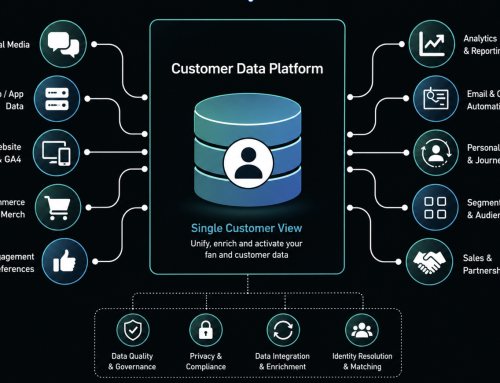
3) The database format (usually) allows you to replicate some CRM functionality. As an example, building list segments based on data attributes and merging lists on a unique ID to create an SCV will introduce you to some key CRM principles.
4) The email campaign introduces workflow automation. Functionality will (usually) include triggered campaigns and other formats that will introduce you to the efficiencies of marketing automation.
5) The reporting functions introduce you to the benefit of using actionable insights. In turn this will help you to inform your decisions, for example, what to do differently, or the same, in your next campaign.”
Eight years later I stand by every word. Email marketing might be considered the most basic use of data, but you can do it well or you can do it brilliantly. These simple foundations introduce you to data quality management and marketing automation. From there you can move into segmentation and personalisation, all basic principles of digital marketing, fan engagement, and digital transformation.
From Sports Clubs to Individuals, Email Marketing for Athlete Brands
And just as importantly, everything I’ve described above applies equally to an athlete brand as it does to a club or a league. That’s one of the central arguments in book three: the tools and principles are the same, the context is just different. An athlete with a direct line to their audience, through a consented, well-managed email list, has a commercial asset that no social platform algorithm can take away. And if you don’t believe me, look at Tom Brady, the most decorated player in NFL history, who has started using email marketing. That’s right, even though he has over 25 million social followers, he’s added email to his marketing toolbox, launching his own newsletter, named 199, in January 2025, referring to it as “an extension of his group chat with friends and family.”
From Email Marketing to Digital Transformation: The ProDataStack Approach
My recommendation to any business, any rights owner, any athlete is focus some of your digital marketing/brand development time on mastering email marketing as a brilliant basic. Not because email is the destination, but because it is the best possible foundation. The disciplines it demands to know your audience, secure their attention, deliver value, and measure the response, are the same required to introduce customer journey mapping across your digital estate, to orchestrate a seamless cross-channel journey, or to design an omnichannel strategy where every touchpoint reinforces the last. These are not different skills – they are the same skills applied at greater scale and complexity.
Email marketing forces you to think like a data-driven marketer and lays the foundation for true digital transformation.
If you are a sports rights owner beginning your email marketing journey, an athlete brand looking to build a direct audience, or an organisation ready to take the next step in digital transformation we can support you at ProDataStack.
Get in touch with us today or you can explore how we can support you as a Rights Owner or an Athlete Representative on our website.